I quit Kegels at 35. This is what fixed my pelvic floor at 36.
I spent $400 on devices that didn't work, gave up, and accepted that this was just what life looked like now. Then a friend sent me a link.


Three years ago, three months postpartum after my second, my doctor told me to "just do Kegels" the way doctors say things when they are already halfway out the door.
So I did them.
For three weeks I clenched at red lights. I clenched in meetings. I downloaded an app that buzzed when I forgot. By week four I had stopped. By week six I was avoiding sneezing in public.
I assumed I had failed. So I bought the Elvie. Then a Perifit. Then a set of weighted kegel balls with a little instruction booklet I never read. Four hundred dollars total, spread across three years, every one of them in the drawer next to my bed within a month.
I had given up. Quietly. I told myself this was just what postpartum at 35 looked like. Some leaking, some looseness, some flat sex. I crossed my legs when I felt a sneeze coming. I planned my workouts around my bladder. I bought black leggings for boxing class.
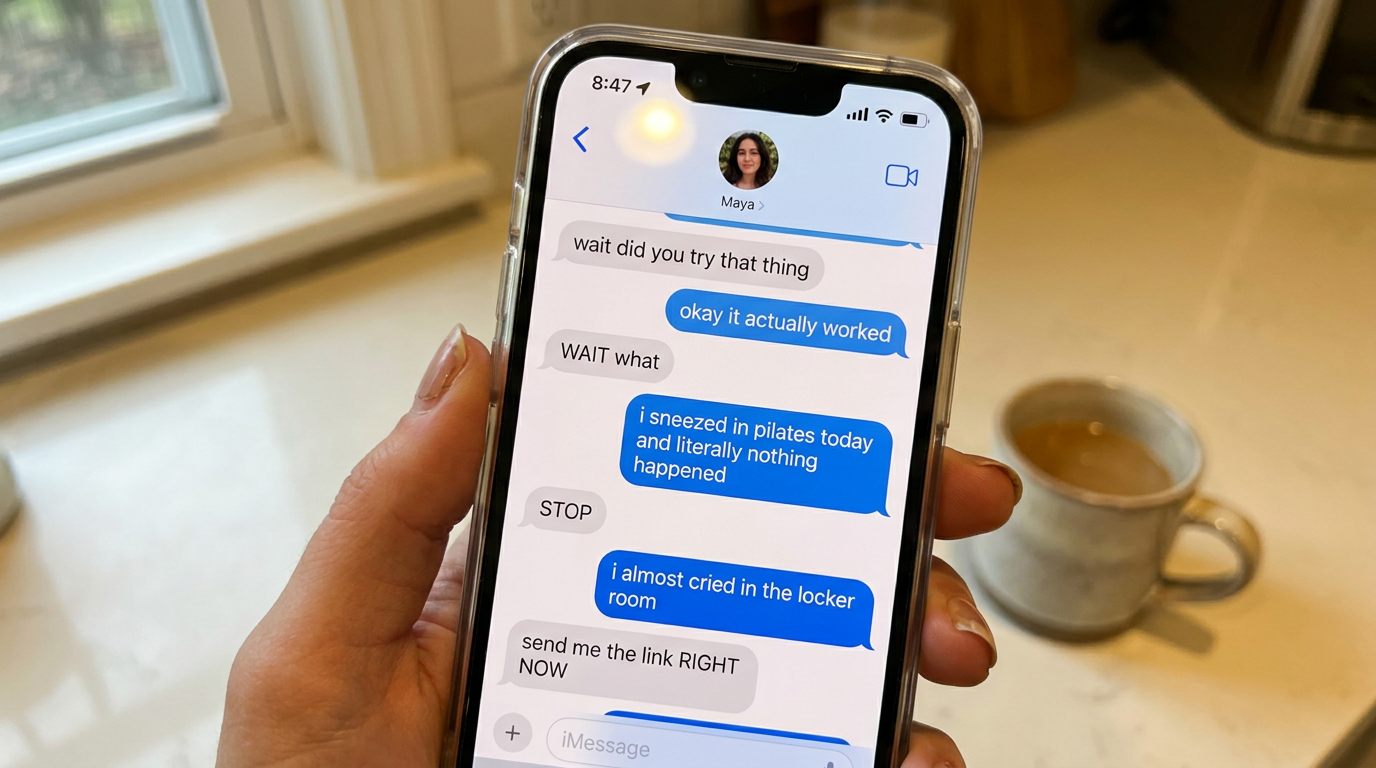
Then last spring my friend Maya texted me a link.
"You have to try this. I am not kidding."
I almost didn't. I had a drawer full of evidence that I was the kind of woman who buys things and doesn't use them.

What was actually wrong with everything I tried
I learned later, from a pelvic floor PT named Dr. Sarah Mitchell, what was actually broken with every device in my drawer.
Elvie and Perifit are biofeedback trainers. They measure your voluntary Kegel contractions and tell you whether you did them well. They do not contract your muscle for you. So the entire premise depends on you, the woman, remembering to contract that muscle 50 to 100 times a day, for 90 days, on a schedule.
That is how all of them work. And it is why 85% of women quit within 21 days — including, apparently, every woman I knew.
Dr. Mitchell told me about something called the Tonic Vibration Reflex. It is a 30-year-old branch of physiotherapy more widely used in France and Germany than the United States. When you expose pelvic floor muscle to a precise vibratory frequency, between 90 and 110 Hz, it contracts on its own. Involuntarily. About 40% harder than the strongest Kegel you can do consciously.
"The reason the devices in your drawer didn't work isn't that you didn't try hard enough," she told me. "It is that they were built around a behavioral assumption that does not survive contact with most women's actual lives."
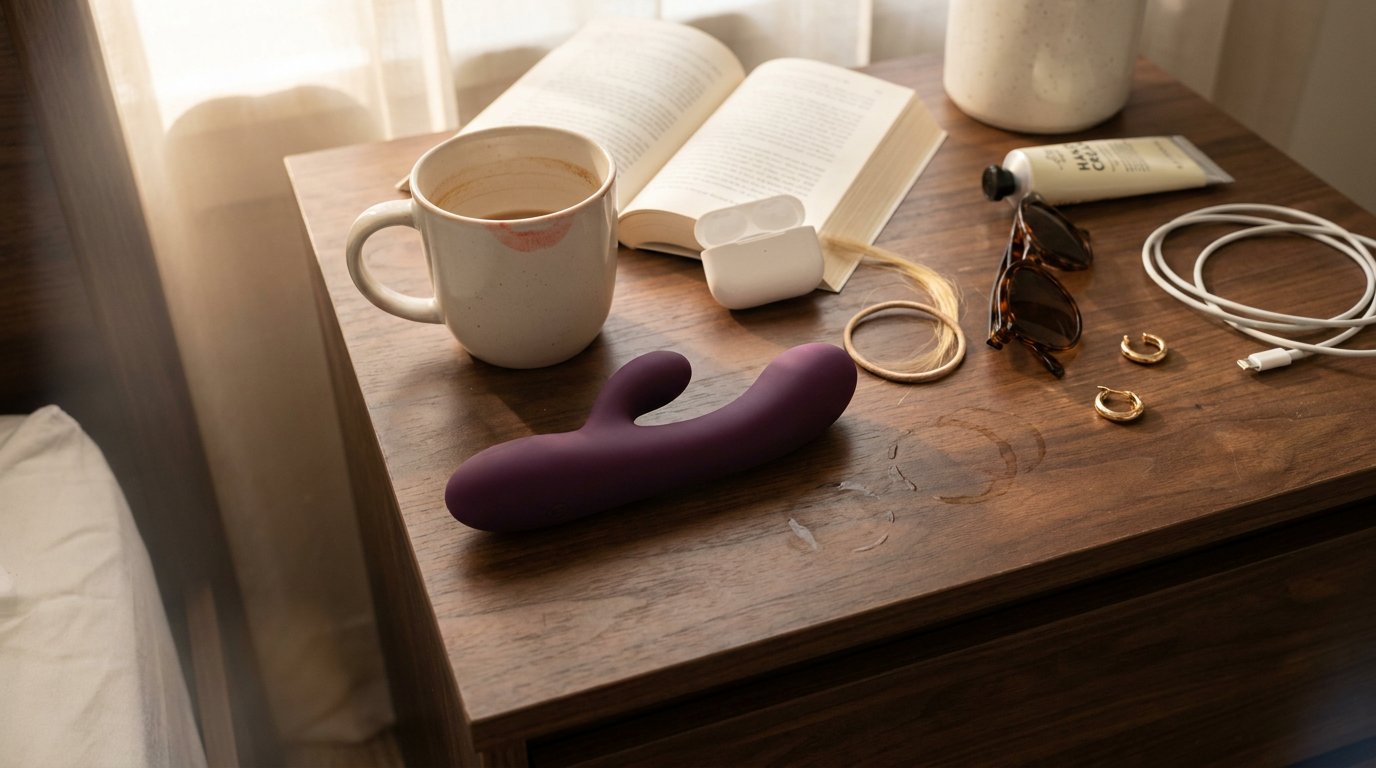
She had a name for the device Maya sent me. She called it "the first piece of pelvic floor equipment I have seen built around how human beings actually behave."
What happened when I actually used it
I will spare you the part where I obsessively researched it for three days before ordering.
It came in a plain unbranded box. I used it for the first time on a Tuesday night at 10 PM with a glass of wine, expecting it to be just like the others.
It wasn't.
Without going into more detail than this paragraph can hold: it is shaped to do four things at once, internally and externally, in a single 12-minute session. The muscles work. I would later count somewhere around 4,000 to 6,000 involuntary contractions per session — more than I had done voluntarily in the entire previous year.
And, this is the part the Elvie marketing team will hate me for saying: I actually wanted to use it the next night. And the night after.
Three weeks in, I sneezed in barre class.
I waited for the wet feeling. It didn't come.
I sneezed again, on purpose, harder.
Nothing.
I almost cried in the locker room.
I am not the only one
After I started telling friends, I found a small thread of women between 28 and 50 who had all gone through some version of this story.
The doctor told me "just do Kegels" after my second pregnancy. I did them for six weeks. I quit. I was depressed about it. This fixed in a month what I couldn't fix in two years of trying to be disciplined.
I had a $189 Elvie sitting in my drawer for two years. Three weeks with this and I sneezed in barre class without crossing my legs. I almost cried.
I bought it for the pelvic floor stuff because my mom had prolapse and I'm trying to prevent it. The orgasms were a side effect I genuinely did not expect at 47.
The pattern is identical. Stress incontinence improvements within 14 to 28 days. Orgasm intensity changes within 7 to 14 days. Core engagement improvements within 21 to 35 days.

This is a pelvic floor strengthening protocol delivered through a pleasure compliance mechanism. I have watched 200 patients quit Elvie trainers in three weeks. I have not seen a single one quit this device. That is not marketing. That is neurology. Dr. Sarah Mitchell, PT, DPT — Pelvic Floor Specialist
I would add one thing. The device made me realize that for most of my adult life, the women's wellness industry has been selling me discipline as a feature. As if buying the right gadget would teach me to do the boring thing, on time, every day, forever.
It never worked. Not on me. Not on most women.
What worked was a device that didn't require me to be a different person.
Where to find it
The team has limited inventory of the current production run. They are not selling on Amazon, Sephora, or Ulta.
See The Device