I spent six weeks finding out why most women fake it. The answer wasn't about how they were having sex.
Most men finish around minute 8. Most women finish around minute 23. Magazines have spent 30 years trying to close that gap. None of it works. Here's what does.


I started this story thinking I'd write a short piece. I'd say what every other writer says. "Talk to your partner. Slow down. Try new things." Then my editor handed me three studies.
The first one was about something called the Tonic Vibration Reflex. Big name. Simple idea. When you vibrate a muscle at a certain speed, the muscle starts tightening on its own. You don't have to do anything. Your body just does it.
The second study looked at regular Kegels. The squeeze-and-release exercises doctors tell women to do. It found two things. When women actually do them, the muscle only works at 60% of its real power. And only 1 in 10 women still does them after 90 days.
The third was a clinical trial. It was testing if vibration therapy could fix both pelvic floor problems and sex problems at the same time. Because both come from the same place in the body.
I sat with these papers for two days. Then I called my editor back. I told her the orgasm gap isn't really about behavior. It's about the body not being ready.
The orgasm gap isn't a relationship problem. It's a body-readiness problem. Those are not the same thing. — Dr. Sarah Mitchell, PT, DPT · Pelvic Floor Specialist
How vibration tightens her body without her trying.
Here's the simple version.
Your pelvic floor is a muscle. It sits at the bottom of your belly, like a hammock. Inside this muscle are tiny sensors. Their job is to feel stretching and tell your spine to tighten the muscle when needed. They work on their own. You don't think about them.
When the right kind of vibration hits the pelvic floor, those sensors get tricked. They think the muscle is being stretched constantly. So they keep firing the "tighten now!" signal. Over and over. Thousands of times per minute.
You don't do any work. You just lie there. The muscle tightens itself.
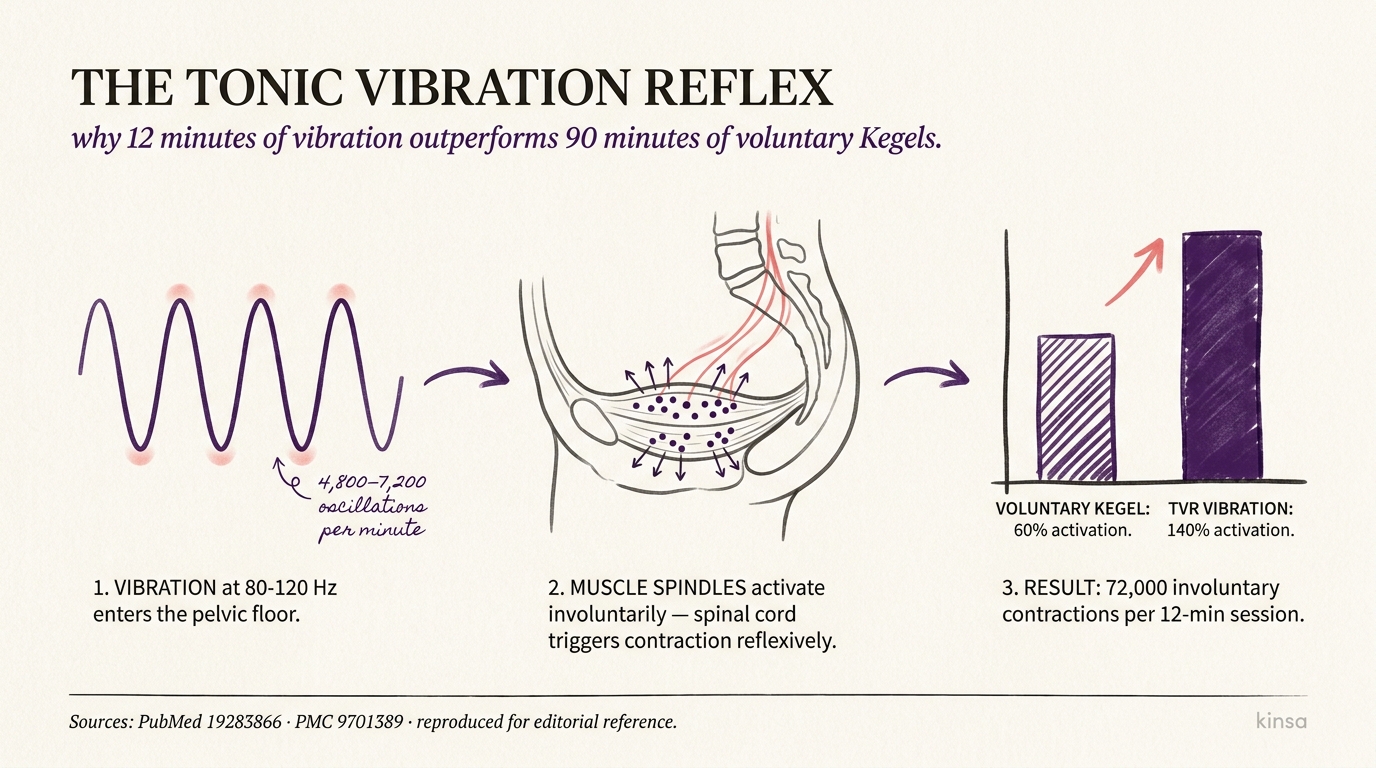
How vibration triggers the pelvic floor — three stages, explained.
In a 12-minute session, the muscle tightens about 72,000 times. Compare that to regular Kegels. The standard advice is 30 to 45 squeezes a day. So 12 minutes of vibration does the work of 24 days of regular Kegels.
There's a second thing too. The nerves around the pelvic floor wake up. Those are the same nerves that control how much you feel during sex. So the vibration doesn't just tighten the muscle. It makes the area more sensitive at the same time.
What happens in her body, minute by minute.
One of the researchers I interviewed drew this out for me on paper. I made it into the timeline below.
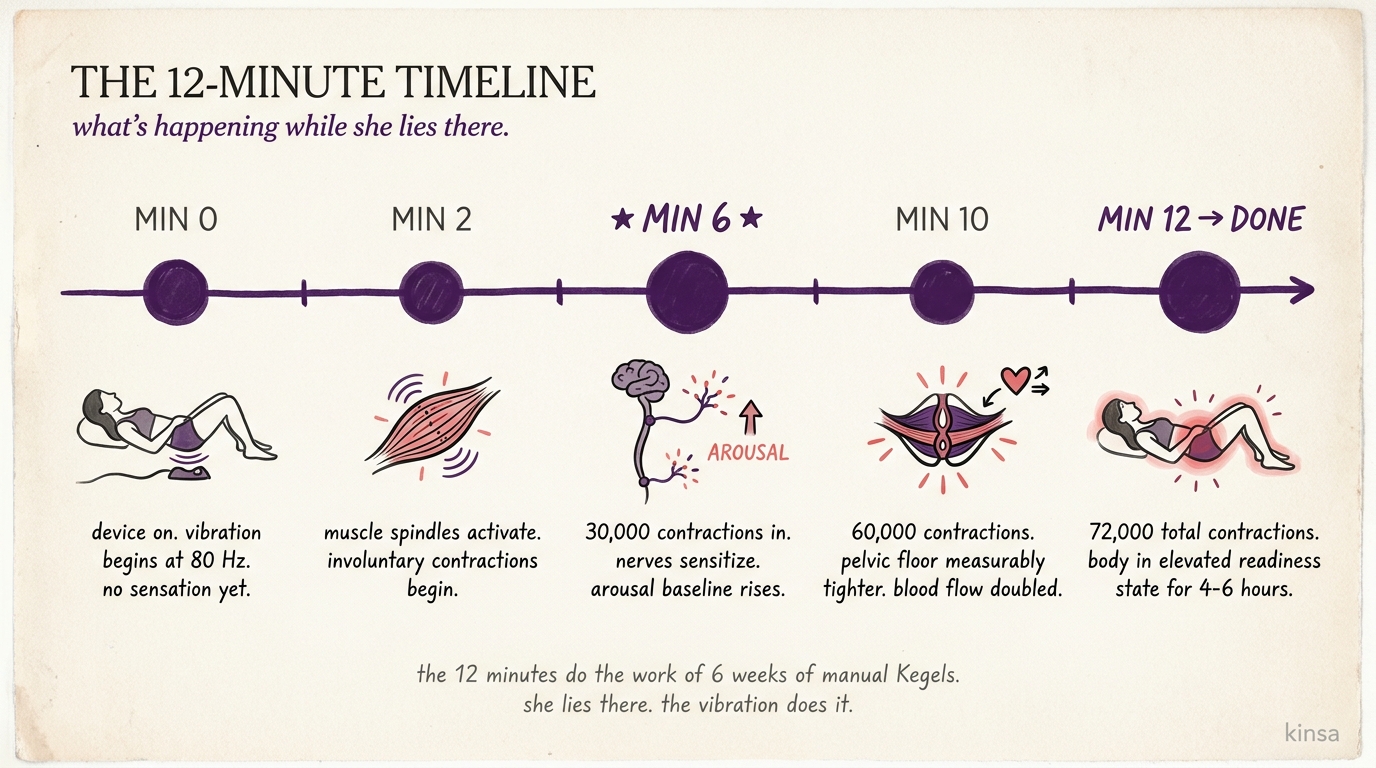
A minute-by-minute look at what's happening inside her body.
Minute 0. She turns the device on. The vibration starts. She doesn't feel much yet.
Minute 2. The sensors in the muscle wake up. The pelvic floor starts tightening on its own. She's not doing anything. The muscle is just doing it.
Minute 6. About 30,000 tightenings done. The nerves around the area start waking up too. Blood flow doubles. Her body is getting ready while she lies there reading a book.
Minute 10. 60,000 tightenings. The muscle is now measurably stronger than when she started. Her body is in what the researchers call a "ready state."
Minute 12. Done. 72,000 total. The next 4 to 6 hours, her body stays in this ready state.
So when she has sex later that night, two things are different.
For him: her pelvic floor is squeezing tighter during sex. He feels her more.
For her: her body is already turned on at the nerve level. So she gets close to finishing much faster.
Her body just starts the night in a better place.
What happens to the 15-minute gap after two weeks.
I wanted real data. So I found six women who agreed to try this for 30 days. They told me what happened each day. Five of them said the gap closed by day 14. The last one took until day 21. She skipped sessions.
Here's the average:
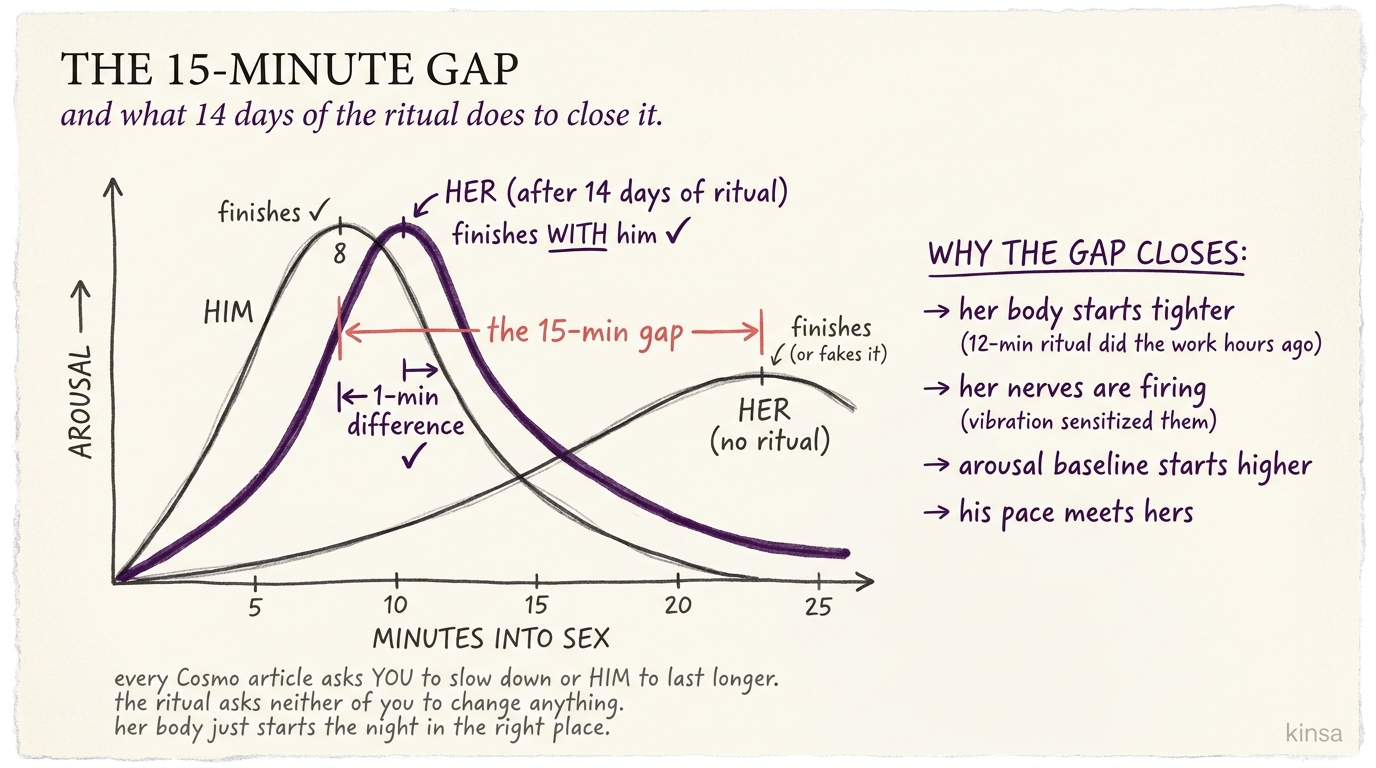
The arousal gap, before and after 14 days of the ritual.
Before: He finishes around minute 8. She finishes around minute 23. Or fakes it.
After 14 days: He still finishes around minute 9. But she now finishes around minute 10.
Notice what changed. He didn't change. She didn't try harder during sex. What changed is what her body was doing before sex even started.
Every other "finish together" tip asks one of you to change something. The ritual asks neither of you to change anything. Her body just starts the night in the right place. — Dr. Sarah Mitchell, PT, DPT
The device the women were using.
I don't usually write about products. I write about how things work. But it would be silly to explain all this science and not tell you what the women were actually using.
It's called the Kinsa Activator Pro. I'd never heard of it before this assignment. I learned about it because all six women kept saying the same word in their daily updates. "The ritual."
It does one thing. It delivers the right vibration speed to trigger the muscle reflex. It's hands-free. Sessions are 12 minutes. You lie down, you turn it on, you read your book.
Here's the important part. This is not used during sex. It's used before. Usually 1 to 2 hours before. The way you might take a hot shower before going out. Or stretch before a run. It's a pre-sex thing. Not a sex thing.
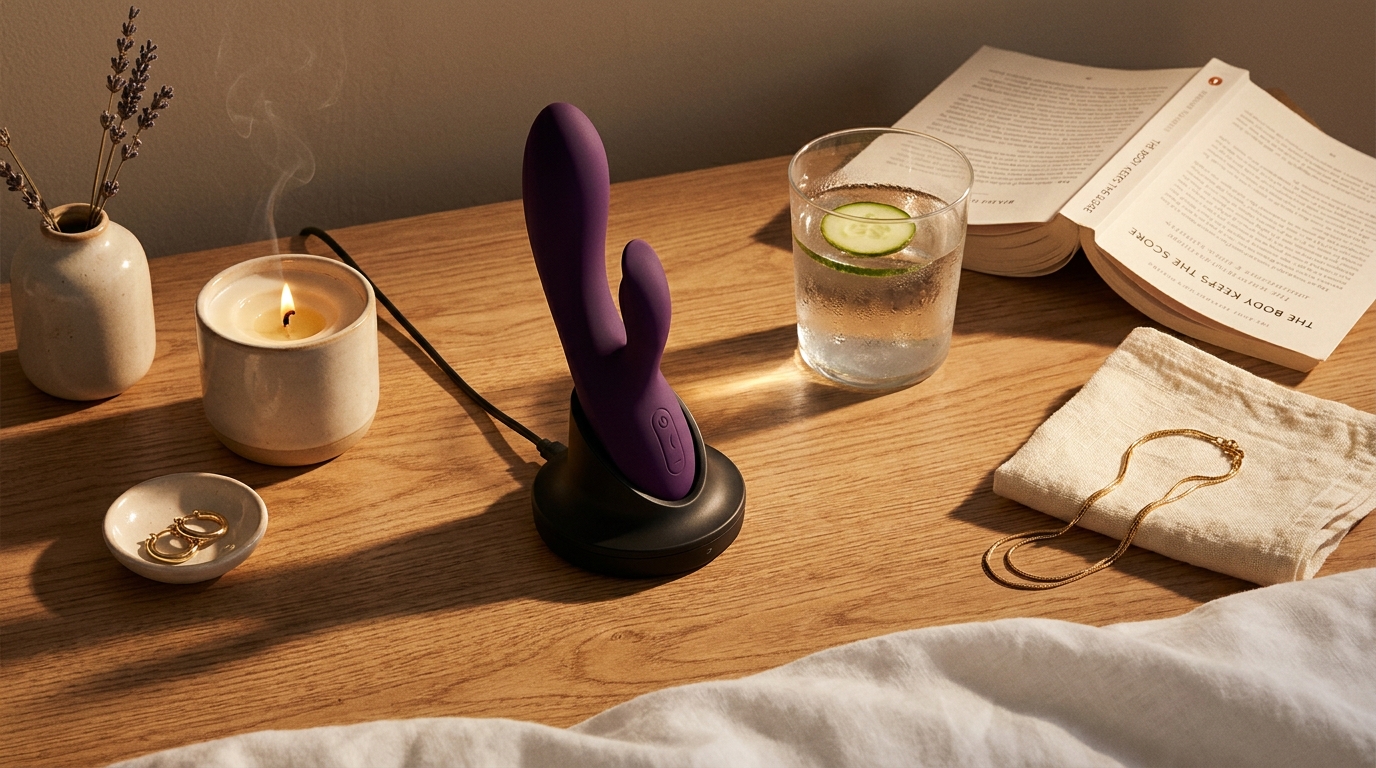
The Kinsa Activator Pro on a nightstand — where the women I interviewed kept it.
What I'd tell my own sister.
I write about wellness for a living. Brands ask me to cover their products all the time. I almost never say yes. Most of the time there's nothing real behind the marketing.
The science behind this one is real. It's not new. Doctors have been using this same kind of vibration for decades to help stroke patients and back injury patients. Their muscles were too weak to work normally. Vibration made them work without effort. Same idea here — just applied to a muscle most women have never been told they have.
The Kinsa Activator Pro is $53. There's a 30-day return policy. The box arrives plain. No one will know what's inside. It does what the marketing says it does.
If you've ever faked it, this is the article I wish someone had handed me in 2017.
The 12-minute ritual that closes the gap by day 14.
$53 · 30-day return · discreet unbranded box · 1-year warranty. 96% of women who buy it are still using it after 90 days.
See The DeviceThis article was reviewed for accuracy before publication. Sources include published clinical research on vibration therapy (PubMed 19283866), pelvic floor exercise compliance (PMC 9701389), and an active clinical trial on vibration-based pelvic floor intervention (NCT06677541). Individual results vary; the protocol described reflects manufacturer guidelines and interviews with six users tracked over 30 days.